Before Push Alerts: How Newsrooms Reached Readers by Edition, Wire, and Broadcast
Before push alerts, newsrooms reached readers through editions, wire services, and broadcasts. See how each route shaped what could be reported and when.
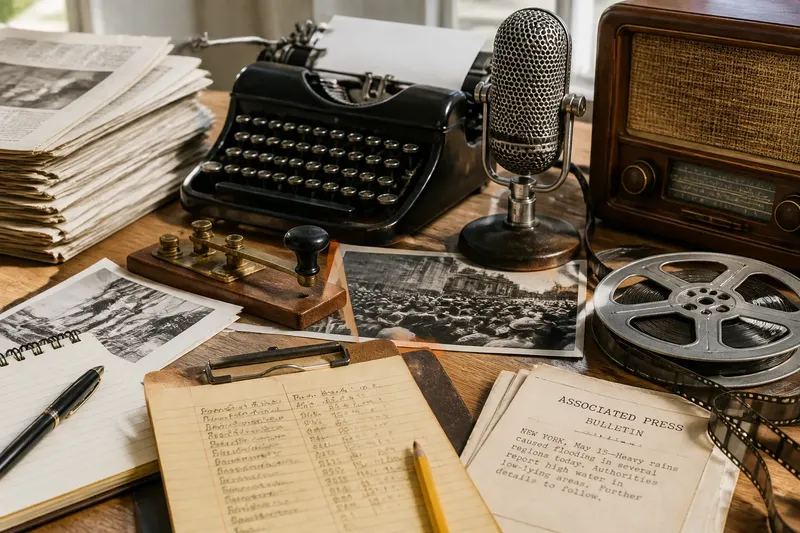
Before a phone could buzz with breaking news, a newsroom had to move information through presses, telegraph wires, or broadcast transmitters. The history of news delivery before push alerts is not simply a march toward faster messages; each system changed how editors gathered, verified, and distributed a report.
Newspaper editions turned deadlines into editorial structure
A newspaper’s edition began with a practical limit: pages had to be assembled, printed, and moved through a delivery network. Editors worked toward a press deadline, choosing which reports belonged in the available space and arranging them into a package readers could encounter at home, at a newsstand, or on the street.
That physical process shaped the reporting itself. A late development might be held for the next edition, squeezed into a short update, or relayed to another newsroom by telephone. Meanwhile, a developing account could grow across editions as reporters confirmed details and editors made room for them. The newspaper was not merely a container for finished stories; its production schedule helped determine when a story could become public.
Morning and evening papers reflected different working rhythms. An evening edition could respond to developments from earlier in the day, while a morning paper had to close well before many readers woke. Local delivery conditions and the distance between a printing plant and its audience also affected what arrived and when. There was no single newspaper clock.
Telegraph wires made distant reporting a shared product
The telegraph changed the movement of news between places before it changed the reader’s daily routine. News organizations and agencies could send dispatches over long distances, allowing papers to print accounts of events beyond the reach of their own reporters. Wire services such as the Associated Press helped member newspapers share reporting rather than each building a separate network everywhere.
A wire dispatch had to travel as text and fit the receiving paper’s needs. Editors might shorten it, rewrite its opening, or hold it for a later edition. The same report could therefore arrive in several local forms, with the wire providing shared material and each newsroom making its own choices about prominence and space.
The wire also made a newsroom’s dependence on infrastructure visible. A message could be delayed by a broken connection, a crowded route, or the time needed to confirm what a correspondent had sent. Faster transmission widened the reporting horizon, but it did not eliminate the work of checking a dispatch or deciding how much authority to give it.
Radio made the bulletin an event in the day
Radio brought news into homes and public places as a voice heard at a particular time. A bulletin had to work for listeners who could not scan backward over a paragraph. Presenters needed to identify people and places clearly, state the main development early, and move through a sequence that made sense on first hearing.
That audible form altered the newsroom’s relationship with the audience. A scheduled bulletin gathered listeners around a shared moment, while live coverage could keep them with an unfolding event. But the sound of immediacy was not the same as complete access: listeners needed a receiver, a suitable time, and a language they could follow. A broadcast could be central to one household’s routine and absent from another’s.
Television added images, but pictures did not do the reporting on their own. A camera could show a scene; narration and interviews still had to establish what had happened, who was involved, and what remained uncertain. The newsroom had to coordinate sound and image without treating visibility as a substitute for explanation.
Newsreels and wire photographs gave print a visual deadline
Before television became a regular household presence, newsreels brought filmed reports to movie theaters. Audiences encountered a curated sequence of events as part of a cinema program, rather than choosing individual clips on demand. The production and distribution of film meant that images could reach viewers after the event, yet their scale and motion offered a different kind of public encounter from a newspaper photograph.
Wire photographs followed another route. A picture could be transmitted to subscribing newspapers, where editors decided whether it fit the page and how a caption should explain it. The image might travel farther than the photographer, but it still depended on selection, reproduction, and a newsroom’s judgment about what readers needed to know.
These visual channels remind us that delivery technology is also an editorial filter. A newsreel favored scenes that could be filmed and assembled for a theater audience; a newspaper photograph had to earn space beside written reports. Neither format made every event equally visible.
Digital alerts inherit old newsroom choices in a new form
Web publishing loosened the connection between a report and a fixed edition. Email, text messages, and smartphone notifications then carried selected updates directly to readers. The alert is brief, but the decision behind it is familiar: editors must judge whether a development is timely enough to interrupt someone and whether the short message says something useful on its own.
Say a local newsroom receives a confirmed notice that a city bridge has closed during the morning commute. An editor first checks the notice’s source, then publishes a web report with the closure, the stated reason, and any available detour information. The editor sends a targeted alert only if the disruption is useful to the intended readers, wording it to identify the bridge and closure; the page holds details that may change. The observable result is a concise notice that communicates the immediate disruption while directing readers to fuller information.
What is not worth the effort is turning every small edit into an interruption. A correction that does not change what readers need to do may belong in the story itself, not in a fresh alert. The channel should follow the editorial value of the update, not the mere availability of a send button.
Which news route fits the reader’s need?
Why did newspapers publish editions?
Presses and delivery networks required papers to close and distribute content in batches. An edition let editors gather reports into a package, but it also meant late developments might wait for a later printing.
What did telegraph wires change for newspapers?
They helped news organizations transmit dispatches across long distances, giving local papers access to reporting from elsewhere. Receiving editors still had to verify, select, and adapt that material for their own pages.
How was a radio bulletin different from a newspaper report?
A bulletin reached listeners as a spoken sequence, often at a scheduled time, so names and the central development had to be clear on first hearing. A newspaper offered text and page layout that readers could scan or revisit.
What is the historical difference between a wire dispatch and a push alert?
A wire dispatch moved reporting between news organizations, where editors could shape it for publication. A push alert sends a short prompt to a reader’s device, usually pointing toward a fuller digital report.
News delivery history is a history of editorial decisions
Each route set different conditions for a report. A press deadline shaped what could make an edition; a telegraph wire carried dispatches between organizations; a radio bulletin organized news for listening; a newsreel and a wire photograph made images part of the report; a phone alert delivered a compact prompt to an individual screen.
The history of news delivery before push alerts offers a useful question for editors: what can the reader understand from this format at the moment it arrives, and what still needs a fuller account? A good route does more than move information. It gives the report a form that suits its evidence, its urgency, and the reader’s next decision.